
DyNAtrix for Organ-on-Chip: An Application Note
Team Dynamic Matrices | 9 September 2026
Organ-on-chip platforms depend on the hydrogel doing three unglamorous things well: loading into a microfluidic channel without leaking past the confinement structure, staying put once perfusion starts, and holding up biologically over the full length of the experiment. This application note covers all three for DyNAtrix, using standard trapping-post chip geometry with a central gel channel flanked by two perfusion lanes.
Introduction
Most hydrogels developed for well-plate culture were never tested against the geometry of a microfluidic chip. A gel that behaves perfectly in a 96-well plate can leak past a trapping-post array before it sets, or degrade under the shear of continuous perfusion in ways that never show up in static culture. Because DyNAtrix gels via a bioorthogonal crosslinking reaction rather than a temperature- or pH-triggered set, and its stress-relaxation and stiffness are independently tunable (see What Makes a Hydrogel “Dynamic”?), we wanted to check that those same properties translate cleanly into an on-chip context. This note reports internal validation data on three practical questions: does the precursor load and confine correctly, does the confinement hold once perfusion starts, and does the resulting culture stay stable over a multi-day experiment.
Materials
- DyNAtrix hydrogel kit (liquid precursor and crosslinker components)
- Microfluidic perfusion chip with standard trapping-post geometry: a central gel-loading channel flanked by two media/perfusion channels, separated by an array of trapping posts
- Colorimetric tracer dye, for the confinement/diffusion assay
- Cyst-forming epithelial cell line, for the long-term culture assay
- Standard culture medium and a perfusion system for continuous media flow through the chip
Methods
Chip loading. DyNAtrix precursor was pipetted directly into the central gel channel of the chip and allowed to gel in place before flanking media channels were filled.
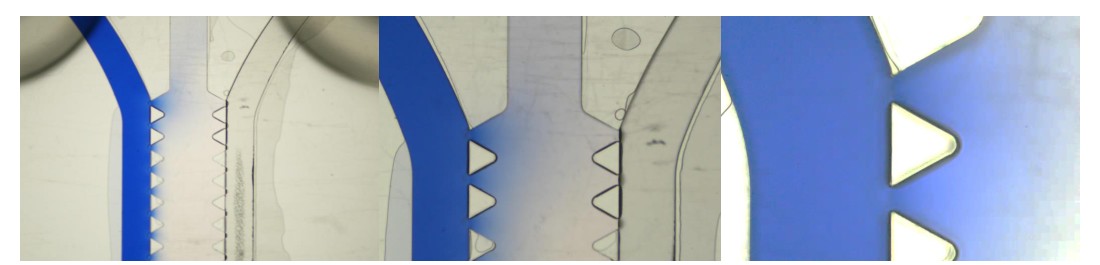
Confinement verification. Once the gel had set and perfusion began, a colorimetric tracer was flowed through the media channel on one side of the post array. Diffusion of the tracer across the posts and into the gel channel was imaged over time to check whether the barrier stayed intact under flow.
Long-term culture. Cyst-forming epithelial cells were cultured within the gel channel under continuous perfusion for 11 days. Structure formation was scored by imaging at Day 5, Day 7, and Day 11, and reported as the percentage of cysts showing correct apical-in polarity.
Results and Discussion
Loading and confinement
The central gel channel in a perfusion chip is separated from the flanking media lanes by an array of trapping posts, typically triangular or trapezoidal, spaced closely enough to hold a liquid hydrogel precursor in place by surface tension while it gels, but open enough to allow small-molecule and nutrient exchange once it has set. If the precursor is too thin or gels too slowly, it leaks through the posts into the media channel before it sets. DyNAtrix loaded directly into this geometry as a liquid precursor and formed a stable gel in place, with no leakage past the post array observed during loading.
A confined gel with an intact barrier shows a gradual concentration gradient as tracer diffuses across the posts, rather than the tracer flooding straight through. That is what we observed: the dye diffusion pattern confirmed the posts were still doing their job of confinement while remaining permeable to small molecules under active flow.
Long-term culture under perfusion
Loading cleanly is only useful if the culture holds up over time. Apical-in cyst formation stayed within a narrow band across all three timepoints measured under continuous perfusion: 89.88% at Day 5, 92.80% at Day 7, and 88.63% at Day 11, with no downward trend as culture time increased.
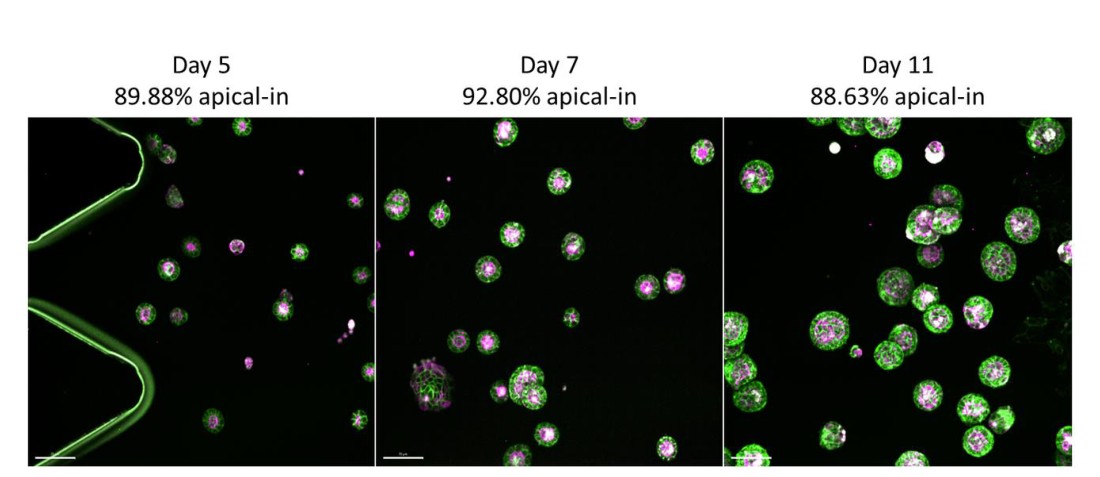
That consistency matters more than any single-day number: it means the matrix is not degrading or losing its mechanical properties under continuous flow in a way that would compromise the biology over the course of a multi-day experiment. For labs building organ-on-chip assays, the practical takeaway is that DyNAtrix can be dropped into existing trapping-post chip designs without redesigning the hardware around the matrix. Loading uses the same liquid-to-gel handling researchers already use off-chip, confinement holds under active perfusion, and structure formation remains stable well beyond the typical few-day window most chip experiments run. That leaves the actual experimental variable, whatever flow, gradient, or multi-tissue condition the chip is built to test, as the thing that changes between conditions, rather than the matrix itself becoming a confound.
References
The loading, confinement, and 11-day perfusion culture data reported here are internal validation results generated at Dynamic Matrices and have not been submitted for peer-reviewed publication. For published, peer-reviewed work on the underlying DyNAtrix material properties referenced in this note, see: Peng, Hsiao, Gupta, et al., Nature Nanotechnology, 2023; Hsiao, Mukenhirn, Werner, Honigmann, Krieg, Advanced Functional Materials, 2025.
FAQs
Yes. DyNAtrix loads as a liquid precursor and gels in place, so it works with standard trapping-post chip geometries used to confine a central gel channel between two perfusion lanes, without requiring a custom chip design.
In internal validation, cultures maintained consistent structure formation (88-93% apical-in) across an 11-day perfusion period, with no indication that this is an upper limit.