
What Makes a Hydrogel "Dynamic"?
Team Dynamic Matrices | 2 March 2026
The word "dynamic" gets applied to a lot of hydrogels, and it does not always mean the same thing. Our working definition: a dynamic hydrogel is one whose mechanical or biochemical properties can change after the gel has formed, in a way you can specify. A static hydrogel holds whatever properties it had at gelation until the experiment ends. Everything else in this post follows from that distinction.
Why the distinction matters biologically
Living tissue is never at steady state. Stiffness, porosity, ligand presentation and growth-factor availability shift through development, healing and disease, sometimes over hours and sometimes over months. A static gel captures one moment of that trajectory. If you want to study a process that unfolds in time (organoid maturation, fibrosis, a stem cell niche responding to injury), a static gel forces you to run separate experiments at fixed states and infer the trajectory between them. A dynamic gel lets you run the trajectory.
The two properties that matter most are:
- Stiffness, which cells sense through integrins and transduce via YAP/TAZ and related pathways (Engler et al., Cell, 2006; Dupont et al., Nature, 2011)
- Stress relaxation, the rate at which the matrix dissipates applied stress. Chaudhuri et al. (Nature Materials, 2016) showed that at constant stiffness, faster relaxation changes MSC spreading, proliferation and lineage. Native tissues relax on timescales from under a second to minutes.
A gel that lets you set both, independently, and change them after encapsulation, is dynamic in the sense that counts.
The trigger mechanisms, and their trade-offs
| Mechanism | Example chemistries | Precision | Reversible | Cell disruption | Equipment |
|---|---|---|---|---|---|
| Light | Photodegradable PEG (Kloxin et al., Science, 2009), photo-crosslinkable methacrylates | High spatial | Usually one-way | UV can damage; visible-light systems better | Light source, sometimes patterned |
| Temperature | PNIPAAm, thermoresponsive block copolymers | Low | Yes | Thermal shifts stress cells | Incubator only |
| Ions | Ionically crosslinked alginate (Chaudhuri 2016) | Medium | Yes | Ca2+ changes affect signalling | None |
| Enzymes | MMP-cleavable peptides, transglutaminase | Cell-driven or added | Degradation one-way | Minimal | None |
| Molecular addition | DNA strand displacement, host-guest, boronate esters | High sequence specificity | Yes | Minimal | None |
Each has a place. Light gives spatial patterning nothing else can. Enzyme cleavage lets cells remodel the gel themselves. Molecular triggers, and DNA in particular, offer high specificity with nothing more than a pipette.
How DNA crosslinking does it
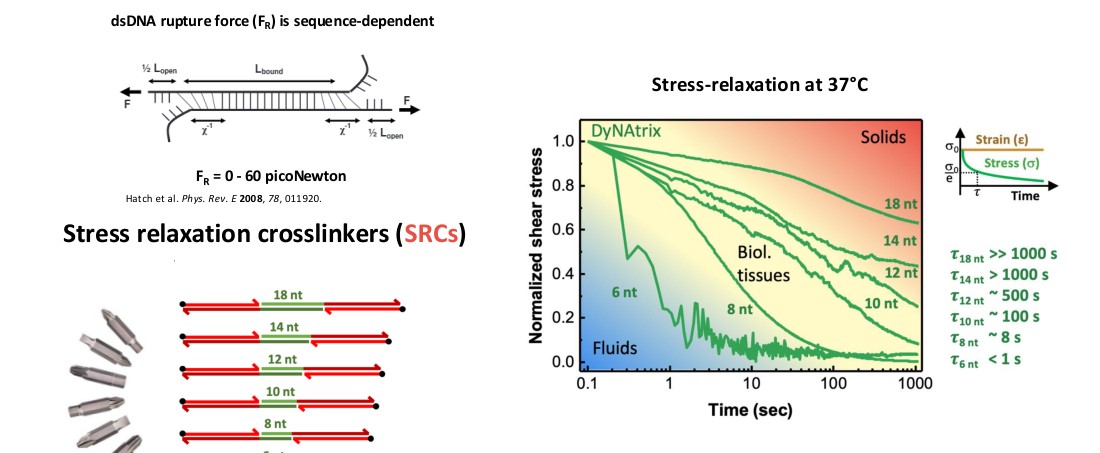
In DyNAtrix, a linear polyacrylamide backbone is crosslinked by short synthetic DNA duplexes. Three things fall out of that design:
Stress relaxation is encoded in sequence. A DNA duplex under force ruptures at a load that depends on its length and sequence, roughly 0 to 60 piconewtons. Crosslinks that rupture easily give a fast-relaxing gel; strong ones give a slow-relaxing gel. In practice this spans about five orders of magnitude in relaxation time from one polymer backbone (Peng et al., Nature Nanotechnology, 2023).
Stiffness is set separately. Polymer and crosslinker concentration set the modulus, from tens of pascals to several kilopascals, without changing the relaxation behaviour.
Changes are triggered by adding a strand. Add a complementary strand and crosslink density rises; add a displacing strand and it falls. Both happen at 37 °C in culture medium with high sequence specificity, so no light source, no temperature shift, no ion swap. And a nuclease dissolves the whole gel in minutes for gentle cell recovery.
Adhesion peptides (RGD, GFOGER and others) are attached to the backbone independently, so biology is a third dial.
What "dynamic" does not mean
It does not mean the gel is unstable or drifting. A well-designed dynamic gel is stable until you trigger it, and DyNAtrix holds its properties at room temperature and through weeks of culture. Dynamic means controllable in time, not uncontrolled.
References
- Engler AJ et al. Matrix elasticity directs stem cell lineage specification. Cell 126, 677–689 (2006).
- Dupont S et al. Role of YAP/TAZ in mechanotransduction. Nature 474, 179–183 (2011).
- Chaudhuri O et al. Hydrogels with tunable stress relaxation regulate stem cell fate and activity. Nat Mater 15, 326–334 (2016).
- Kloxin AM et al. Photodegradable hydrogels for dynamic tuning of physical and chemical properties. Science 324, 59–63 (2009).
- Rosales AM, Anseth KS. The design of reversible hydrogels to capture extracellular matrix dynamics. Nat Rev Mater 1, 15012 (2016).
- Peng Y-H et al. Dynamic matrices with DNA-encoded viscoelasticity support the development of organoids and stem cells. Nat Nanotechnol (2023).
FAQs
Some designs use several crosslinker modules that respond to different strands or stimuli, enabling sequential transitions. Others allow one transition. Ask what the design supports before planning a multi-step experiment.
DNA-triggered and other molecule-triggered systems need only standard culture equipment. Light-triggered systems need a suitable source and often a way to protect cells from off-target wavelengths.
By our definition, a viscoelastic gel is dynamic at the molecular scale because its crosslinks rearrange under load. A gel is dynamic at the experimental scale when you can change its properties on demand. DyNAtrix does both; some viscoelastic gels do only the first.