
Why Most Pulldowns Cost You the One Thing You Wanted to Keep
Team Dynamic Matrices | 26 November 2025
You pull down a protein because you want to know what it does: its activity, its partners, its state in the cell. Then you elute it by boiling in SDS or dropping the pH to 2.5, and what comes off the beads is a denatured chain. By the time the activity assay runs, you are measuring what survived purification, not what the protein was doing. We think this is the most under-discussed compromise in affinity capture, and it is the reason we built a release step that does not require it.
The tension built into affinity capture
Capture has to bind tightly enough to survive washes that remove contaminants. Release has to break that bond. The tighter the capture, the harsher the release. The numbers:
- Biotin-streptavidin has a dissociation constant around 10⁻¹⁴ to 10⁻¹⁵ M, among the strongest non-covalent interactions known (Green, Methods in Enzymology, 1990). Breaking it needs boiling in SDS, 8 M guanidine, or prolonged formamide. None is compatible with a folded protein.
- Antibody-antigen interactions run 10⁻⁸ to 10⁻¹² M. Elution is 0.1 M glycine at pH 2.5 to 3, or SDS sample buffer, or competition with a peptide when one exists. Low pH unfolds many proteins and dissociates multi-subunit complexes.
- Ni-NTA (His-tag) elutes with imidazole under mild conditions, which is why it is the go-to for recombinant work, but it requires an engineered tag and does not work on endogenous protein.
- FLAG and Strep-tag II elute by competition with FLAG peptide or desthiobiotin under native conditions; these are the gentle options, again only for tagged proteins.
For an endogenous protein, or a complex from a native lysate, the standard choices are denaturing.
What you lose
Three things, and they compound.
Catalytic activity. Enzymes assayed after denaturing elution and refolding show a fraction of native activity, and the fraction is unpredictable. Kinetic constants measured on such preparations are not the protein's.
Complex integrity. Multi-subunit enzymes and allosterically regulated proteins fall apart under SDS or low pH. Elute a proteasome or a polymerase holoenzyme by boiling and you have subunits.
Transient and weak interactions. The interactions with the most biological information are often the weakest. Stringent washes and harsh elution lose them first, and the inter-lab variation in "how stringent" is a large part of why interactome studies disagree.
How phase-separation capture avoids the trade-off
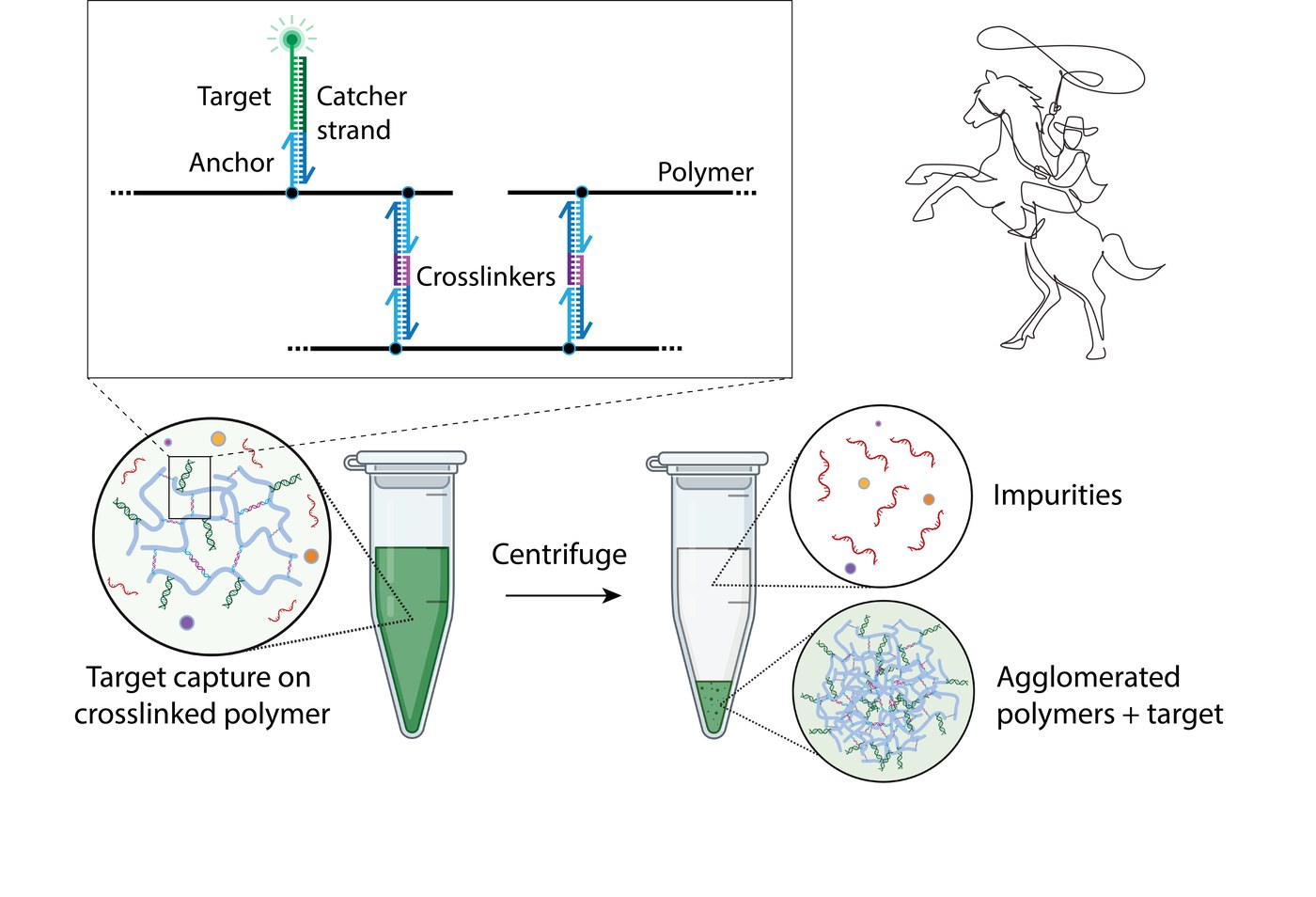
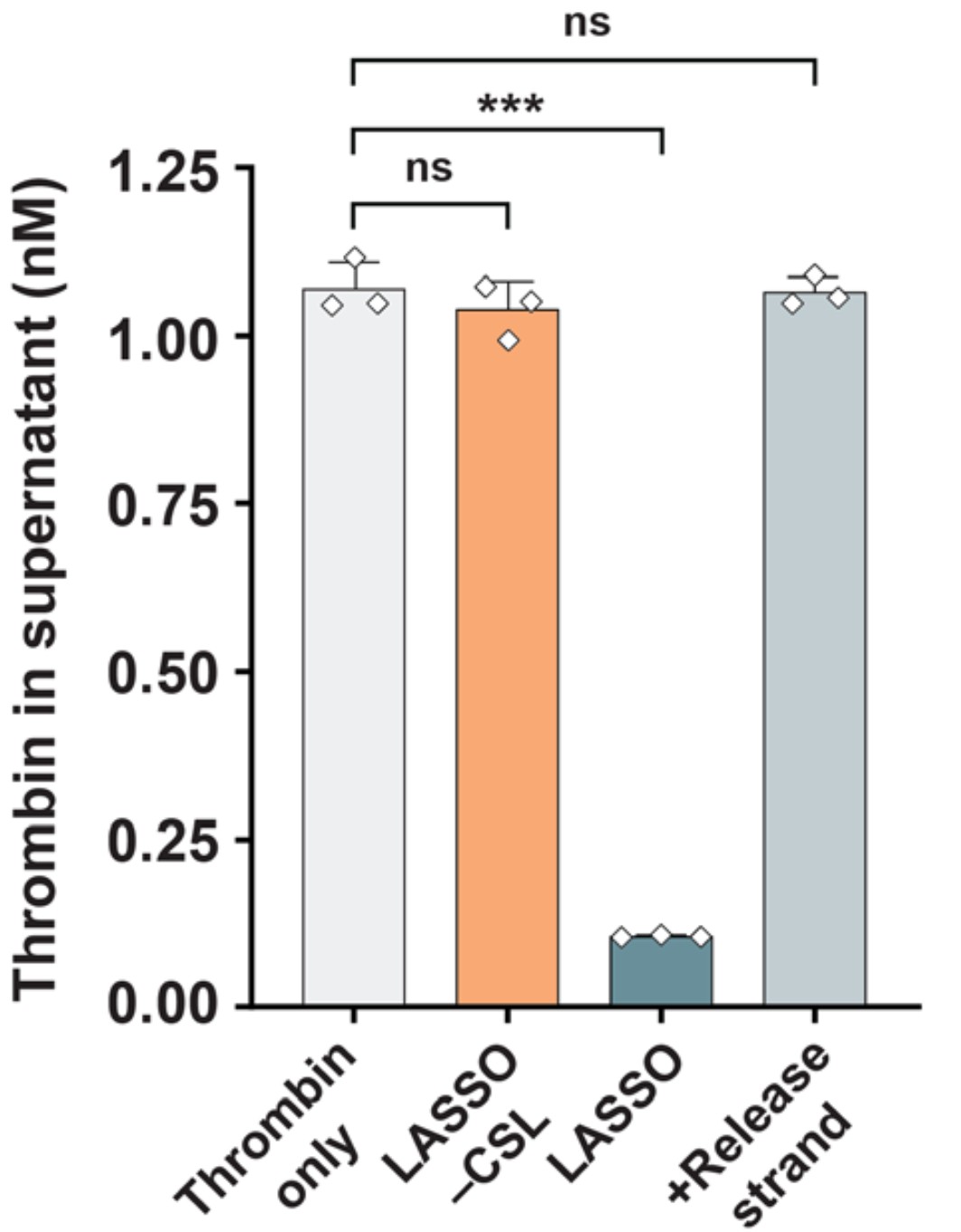
LASSO does not use a high-affinity bond between bait and support. A DNA-based capture element (an aptamer, or a DNA strand hybridised to a tag on an antibody or nanobody) is carried on a soluble polymer. When the capture element binds its target and neighbouring polymer chains crosslink through DNA hybridisation, the network undergoes a phase change and condenses into a pellet in solution. Contaminants stay in the supernatant. The target is held by the network, not by a 10⁻¹⁵ M bond.
Release is by addition of a complementary strand that displaces the crosslink, or by a small change in ionic strength or temperature that reverses the phase transition. Both happen in the same physiological buffer used for capture: no acid, no SDS, no denaturant. The protein comes out folded, in its complex, at the state it was captured (Dynamic Matrices, Angewandte Chemie, 2025; patent WO 2025/196123A1).
What this makes possible
- Kinetic assays straight after pulldown, with no refolding step and no recovery period, because activity was never lost.
- Intact complexes for structural work or for mapping subunit composition by native mass spectrometry.
- Reproducible interactome data, because release stringency is defined by a DNA sequence rather than by an operator's judgement of how long to wash.
- Reagent stability. The capture chemistry is DNA and polymer, stable for about a year at 4 °C, rather than an antibody batch.
Where it does not replace the alternatives
If you only need to identify what was bound (mass spec after denaturing elution), a biotin or antibody pulldown is validated and fine. If your target has a His tag, Ni-NTA is cheap and gentle already. LASSO earns its place when the protein has to come back alive.
References
- Green NM. Avidin and streptavidin. Methods Enzymol 184, 51–67 (1990).
- Schmidt TGM, Skerra A. The Strep-tag system for one-step purification and high-affinity detection or capturing of proteins. Nat Protoc 2, 1528–1535 (2007).
- Mellacheruvu D et al. The CRAPome: a contaminant repository for affinity purification–mass spectrometry data. Nat Methods 10, 730–736 (2013).
- Gingras A-C, Gstaiger M, Raught B, Aebersold R. Analysis of protein complexes using mass spectrometry. Nat Rev Mol Cell Biol 8, 645–654 (2007).
- Dynamic Matrices. LASSO: sequence-selective biomolecule isolation by programmable polymer phase separation. Angew Chem Int Ed (2025); patent WO 2025/196123A1.
FAQs
It needs a recognition element: an aptamer, or an antibody or nanobody conjugated to a DNA handle. For targets with existing aptamers it is antibody-free.
Physiological salt, neutral pH, room temperature or 37 °C. Strand-displacement release adds an oligonucleotide and nothing else.
Yes. Capturing by the RNA sequence and releasing natively brings the bound proteins along intact, which is one of the applications we are most often asked about.