
Why Matrix Stiffness Alone Doesn't Tell the Whole Mechanobiology Story
Team Dynamic Matrices | 22 October 2025
For twenty years, if a paper reported one mechanical property of a cell culture matrix, it was stiffness. Young's modulus, storage modulus, elastic modulus: different measurements of the same idea, how much the material resists deformation. Stiffness earned that attention. Engler et al. (Cell, 2006) showed it directs MSC lineage; Paszek et al. (Cancer Cell, 2005) showed it drives malignant phenotypes in mammary epithelium; Levental et al. (Cell, 2009) showed stiffening the ECM promotes tumour progression in vivo. None of that is wrong. It is incomplete, and the missing pieces change conclusions.
Cells push, wait, and feel what happens
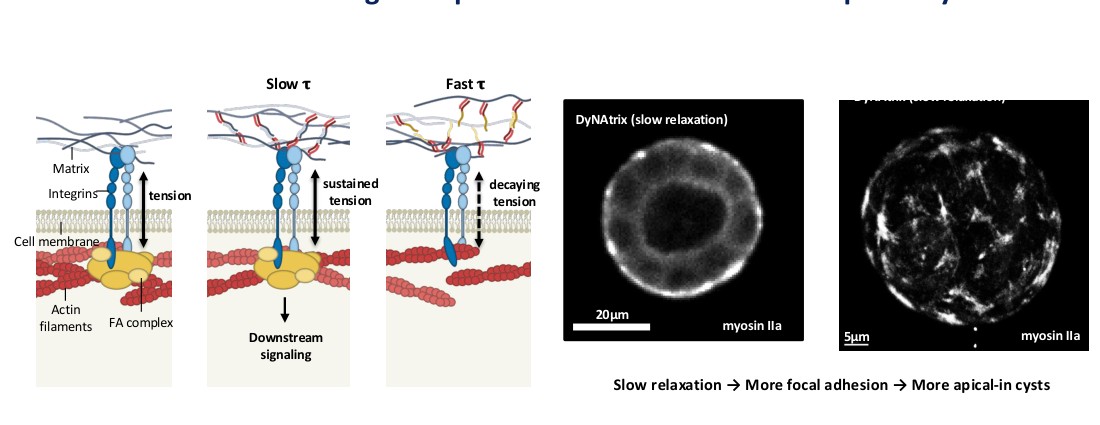
A cell pulling on its matrix through integrins and actomyosin does not just measure how hard the matrix pushes back. It measures how that resistance changes over the seconds it holds the pull. In a purely elastic material, the resistance is constant. In a viscoelastic one, it fades. In a plastic one, the matrix stays deformed after the cell lets go. These three behaviours, elasticity, stress relaxation and plasticity, are distinct, and living tissue has all three.
Stress relaxation changes fate at constant stiffness
The definitive experiment is Chaudhuri et al. (Nature Materials, 2016). Alginate gels were tuned to the same initial modulus but different relaxation times by varying polymer molecular weight and PEG spacers. At identical stiffness, MSCs in faster-relaxing gels spread more, proliferated more and underwent more osteogenic differentiation. Slower relaxation pushed cells toward adipogenesis. Stiffness had not changed; fate had.
The finding generalised quickly. Neural progenitors respond to relaxation as strongly as to stiffness in choosing astrocytic fate (Madl et al., Nature Materials, 2017). Intestinal organoid formation depends on gel remodelability (Gjorevski et al., Nature, 2016). Chaudhuri, Cooper-White, Janmey, Mooney and Shenoy reviewed the field in Nature in 2020 and concluded viscoelasticity is a fundamental regulator of cell behaviour, not a secondary one.
Plasticity governs how cells move through 3D
In 3D, a cell has to make room for itself. In a purely elastic gel the only ways through are protease degradation or squeezing through pores. In a plastic gel, cells can physically push the matrix aside and it stays pushed. Wisdom et al. (Nature Communications, 2018) showed that breast cancer cells migrate through plastic matrices by mechanical remodelling, protease-independently, and that migration tracked matrix plasticity rather than stiffness. Remodelable matrices reproduce how cells navigate real tissue; elastic ones force an artificial mode of movement.
The confounding problem in conventional gels
Here is the practical issue. In most hydrogels the three properties are coupled and fixed:
- Covalent PEG or polyacrylamide gels are essentially purely elastic. Stiffness can be tuned; relaxation cannot.
- Collagen and fibrin are viscoelastic and plastic, but relaxation, plasticity, stiffness, fibre architecture and ligand density all change together with protein concentration.
- Basement membrane extracts have whatever mechanics the lot came with.
So when a paper reports that cells behaved differently at "higher stiffness" in collagen, it cannot say whether stiffness, relaxation, plasticity or ligand density drove the effect. All four moved.
What independent control lets you ask
A matrix where stiffness and stress relaxation are separate dials makes the confounded experiment a clean one. In DyNAtrix, stiffness is set by polymer content and relaxation by the DNA crosslinker sequence, over about five orders of magnitude in relaxation time. You can hold stiffness fixed and sweep relaxation, or the reverse, and attribute the phenotype to one variable (Peng et al., Nature Nanotechnology, 2023).
What to measure and report
If your experiment involves matrix mechanics, we suggest reporting at least:
- Storage modulus (G') from oscillatory shear rheology at the frequency relevant to cell timescales (0.1 to 1 Hz), or Young's modulus from indentation
- Stress relaxation half-time from a step-strain test: apply a fixed strain and record how long the stress takes to fall to half its initial value
- Loss tangent (G''/G'), a quick indicator of how viscous the gel is
- Where migration matters, a plasticity index: apply a stress, remove it, and report the fraction of deformation that does not recover
A study that reports only Young's modulus has characterised one of at least three variables that cells are known to read.
References
- Engler AJ et al. Matrix elasticity directs stem cell lineage specification. Cell 126, 677–689 (2006).
- Paszek MJ et al. Tensional homeostasis and the malignant phenotype. Cancer Cell 8, 241–254 (2005).
- Levental KR et al. Matrix crosslinking forces tumor progression by enhancing integrin signaling. Cell 139, 891–906 (2009).
- Chaudhuri O et al. Hydrogels with tunable stress relaxation regulate stem cell fate and activity. Nat Mater 15, 326–334 (2016).
- Madl CM et al. Maintenance of neural progenitor cell stemness in 3D hydrogels requires matrix remodelling. Nat Mater 16, 1233–1242 (2017).
- Gjorevski N et al. Designer matrices for intestinal stem cell and organoid culture. Nature 539, 560–564 (2016).
- Chaudhuri O et al. Effects of extracellular matrix viscoelasticity on cellular behaviour. Nature 584, 535–546 (2020).
- Wisdom KM et al. Matrix mechanical plasticity regulates cancer cell migration through confining microenvironments. Nat Commun 9, 4144 (2018).
- Cameron AR, Frith JE, Cooper-White JJ. The influence of substrate creep on mesenchymal stem cell behaviour and phenotype. Biomaterials 32, 5979–5993 (2011).
- Peng Y-H et al. Dynamic matrices with DNA-encoded viscoelasticity support the development of organoids and stem cells. Nat Nanotechnol (2023).
FAQs
Yes. Every result in this post holds stiffness constant to isolate the other variables. The point is that stiffness is necessary but not sufficient to describe a matrix.
AFM or nanoindentation with a hold step gives relaxation at the microscale. If you have neither, ask your matrix supplier for the value; it should be on the certificate of analysis.
Some do (soft viscoelastic PDMS and PAAm variants exist), and cells respond to it there as well (Cameron, Frith and Cooper-White, Biomaterials, 2011). But the effects are largest in 3D, where the matrix confines the cell on all sides.